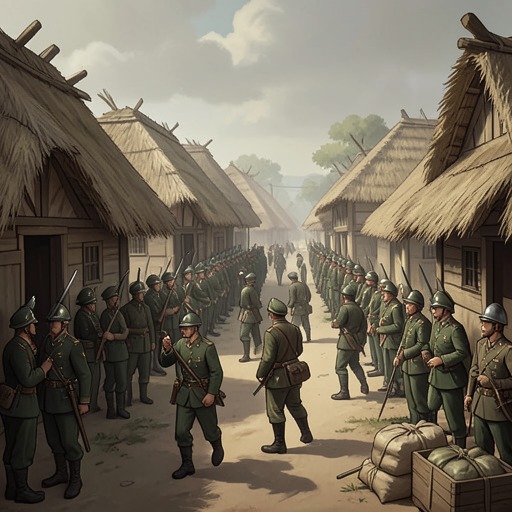
Zybushino
Doctor ZhivagoZybushino is a grain center administered as a subdivision of Meliuzeievo, but its importance and self-image exceed that subordinate status. In June it becomes the site of a two-week independent republic, founded by miller Blazheiko and deserters from the 212th Infantry. Its brief experiment in religiously inflected collectivism ends when forces loyal to the Provisional Government enter the town, sending the deserters back toward Biriuchi. The place’s long-standing reputation for legend and abundance gives this short-lived political episode a setting where local myth, rural prosperity, and revolutionary upheaval converge.
Setting and Regional Character
Two main roads connect Zybushino with the surrounding region. A muddy track runs east through the woods to the town; a gravel road crosses open fields toward Biriuchi, the nearest railway junction. The latter route changes with the seasons, boggy in winter and dry in summer. These roads situate Zybushino between a forested hinterland and the railway network, and later provide the route by which deserters arrive and the direction in which they retreat.
Though administratively attached to Meliuzeievo, Zybushino is described as ahead of it in every way. Its grain trade, merchant prosperity, and exceptionally fertile soil are proverbial. The town also lends its name and customs to a broader western region near the front: popular beliefs, distinctive habits, and oddities of speech are said to have originated there. Its political moment thus grows from a place already imagined as unusually productive and culturally distinctive, not merely as a minor administrative outpost.
A Town of Legends
Zybushino’s reputation reaches back beyond the revolution. Documents from the Times of Troubles mention it, and its thick surrounding forests were long associated with robbers. The landscape and the town’s remembered past furnish a local store of stories before the republic itself becomes another extraordinary tale.
That atmosphere persists in accounts of Blazheiko’s chief assistant. Rumor claims that he is deaf and dumb, but receives the gift of speech during moments of inspiration and then loses it again. The narrative presents this as something people say, not as a verified account. The story belongs to the same legendary register that surrounds the region, where reports of political change and marvels of speech travel together.
The Zybushino Republic
In June, Blazheiko establishes an independent republic with the support of deserters from the 212th Infantry. They have left the front amid the upheavals, retained their weapons, and reached the town by way of Biriuchi. The republic refuses to recognize the Provisional Government and separates itself from the rest of Russia, turning Zybushino’s local autonomy into an explicit challenge to the new national authority.
Blazheiko is a religious dissenter who once corresponded with Tolstoy. He proclaims a millennial kingdom in which work and property are to be collectivized, and calls the local administration an Apostolic Seat. The political project therefore joins radical changes to labor and ownership with religious language and an expectation of a transformed age. Its claim to authority is neither simply administrative nor purely military: it draws upon Blazheiko’s religious vision and the armed deserters who support it.
Suppression and Aftermath
The republic lasts two weeks. In July, a unit loyal to the Provisional Government enters Zybushino, and the deserters fall back on Biriuchi. Their camp lies in a cleared stretch of forest beside the railway junction, among old stumps overgrown with wild strawberries, timber piles reduced by pilfering, and dilapidated mud huts left by seasonal tree-cutters. The retreat transfers the deserters from the town’s brief experiment in self-rule to a rough encampment shaped by earlier labor and continued scarcity.
Zybushino’s episode compresses the instability of the period into a local sequence: armed men arrive from the front, a religious dissenter proclaims a collectivized kingdom beyond the authority of the Provisional Government, and government forces restore their control within weeks. The town’s older traditions of legend and abundance stand in sharp contrast to the provisional republic’s rapid defeat. Its independence is brief, but the attempt makes visible how revolutionary rupture could produce competing authorities at the scale of a single town.